A single car has roughly 30,000 parts. Those parts come from dozens of suppliers in multiple countries, get assembled across plants running three shifts, and need to meet emission, safety, and cybersecurity regulations that shift every few years. Managing that on spreadsheets stopped working a long time ago.
That is where PLM software comes in. Pick the wrong platform and you lose months in launch delays plus millions in rework.
We have helped enough manufacturers make this decision to know the PLM software list is confusing. Every vendor claims they are the best. So we are going to walk through the features that matter for automotive and show where the real differences between PLM software companies show up.
Why automotive companies need PLM software more than most industries
Most industries deal with products that have a few hundred components. Automotive is different. A vehicle platform can carry 30,000+ parts with variants for each market, engine option, and trim level. Engineering teams work on mechanical, electrical, and software systems at the same time. One missed change can delay a launch or trigger a recall.
PLM software keeps all of this connected. Design files, BOMs, supplier specs, test results, compliance documents, everything sits in one system where every team sees the latest version.
PLM software features comparison for automotive industry: where platforms actually differ
BOM management in PLM software
This is the first place where you can tell a strong PLM from a weak one. Automotive BOMs split into engineering, manufacturing, and service BOMs. All three need to stay connected.
Siemens PLM software handles this through Teamcenter, tying mechanical, electrical, and software BOMs into one environment. That matters because modern vehicles run on 100 million+ lines of code. If your PLM treats software data as an afterthought, you end up with version conflicts between teams. We have watched that exact problem delay vehicle programs by months.
Some PLM software companies still bolt on electrical and software management as separate modules. For automotive, that creates gaps.
Change management through PLM software
Automotive programs process thousands of engineering change orders before a vehicle reaches production. A single change to a brake caliper can affect the wheel assembly, the ABS module, the wiring, and the service manual.
Good PLM software tracks each change from request to approval, flags every affected part, notifies the right people, and keeps a full audit trail. When something goes wrong in production, you trace it back to the exact change and who approved it.
We have seen companies run this process in Excel. It holds together until a critical change slips through. Then the cost jumps into seven figures.
Supplier collaboration with PLM software
No automotive OEM builds a car by itself. Tier 1 and Tier 2 suppliers design and produce the majority of components. Your PLM needs to reach outside your own company.
Some platforms on the PLM software list treat supplier access as an optional extra. Siemens PLM software builds it into Teamcenter’s core. Suppliers can view relevant design data, submit changes, and join review workflows without buying a full license. For companies managing hundreds of supplier relationships, this decides whether you catch a problem at the design stage or discover it on the assembly line.
Compliance and traceability
Emissions standards, safety certifications, material declarations, recycling requirements. Automotive regulations keep piling up. Your PLM system should link design decisions to compliance evidence so that when a regulator asks how you verified a safety part, you pull the answer in minutes.
Simulation and digital twin integration in Siemens PLM software
Here the gap between PLM software companies gets wide. Some platforms manage data well but do not connect to simulation tools.
Siemens PLM software is unusual because the same company makes the PLM (Teamcenter), the CAD (NX), simulation tools (Simcenter), and manufacturing planning software (Tecnomatix).
Data moves between these without file conversions. For automotive teams building digital twins of vehicles and production lines, that native integration cuts months off development.
Can free PLM software work for automotive?
We hear this question often, especially from smaller suppliers and EV startups. Free PLM software does exist. For a small team with a single product, it can cover basic document management and simple BOMs.
But free PLM software usually lacks multi-CAD support, compliance automation, and supplier collaboration tools. If you supply parts to an OEM that demands full traceability, you will hit the ceiling fast. Free tools are a fine starting point, not a long-term answer for automotive.
Choosing the right PLM software for your automotive business
Skip the feature checklist approach. Focus on three things instead. Can the platform handle mechanical, electrical, and software data together? Will it scale as your team grows? Does the vendor have real automotive customers you can call?
At CJ Tech, we have spent over 15 years helping automotive companies across India answer these questions. We are an authorized Siemens PLM software channel partner serving 250+ customers, from government organizations to OEMs to MSMEs. Our team knows Teamcenter, NX, and the Siemens portfolio inside out. If you need PLM software that fits your actual workflow, talk to us.
Frequently asked questions
What is PLM software used for in automotive?
PLM software manages a vehicle’s lifecycle from design through manufacturing and service. It connects part data, supplier information, and compliance records in one system.
Which PLM software companies work with automotive manufacturers?
Siemens (Teamcenter), Dassault Systemes (ENOVIA), PTC (Windchill), and SAP all serve automotive. Siemens PLM software is widely adopted for its native PLM, CAD, and simulation integration.
Is free PLM software good enough for automotive suppliers?
For very small teams, free PLM software covers the basics. Suppliers who need traceability and compliance reporting will need a paid platform.
What features matter most in a PLM software features comparison for automotive industry?
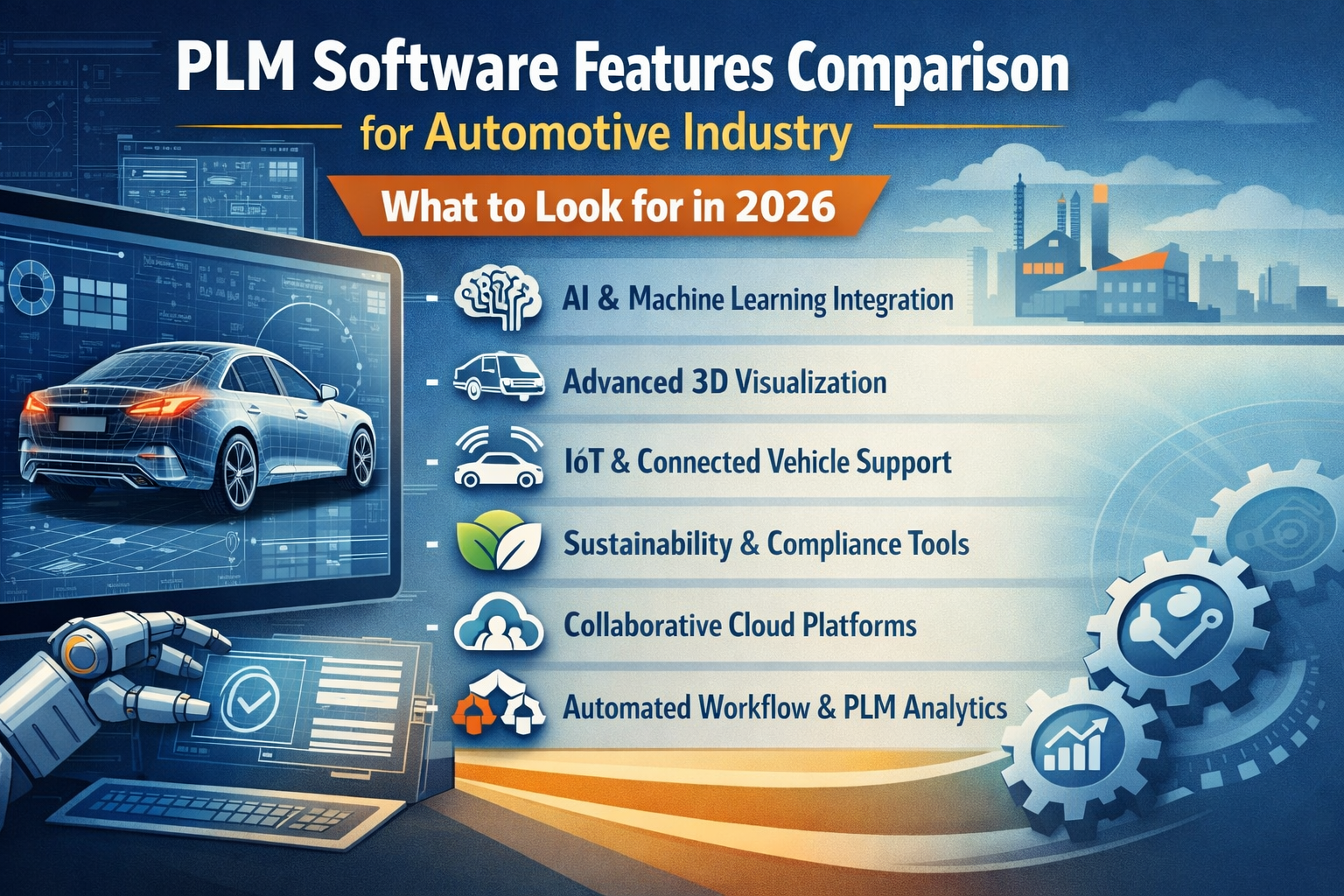
BOM management across multiple disciplines, change management with full traceability, supplier collaboration, compliance automation, and integration with CAD and simulation tools.