
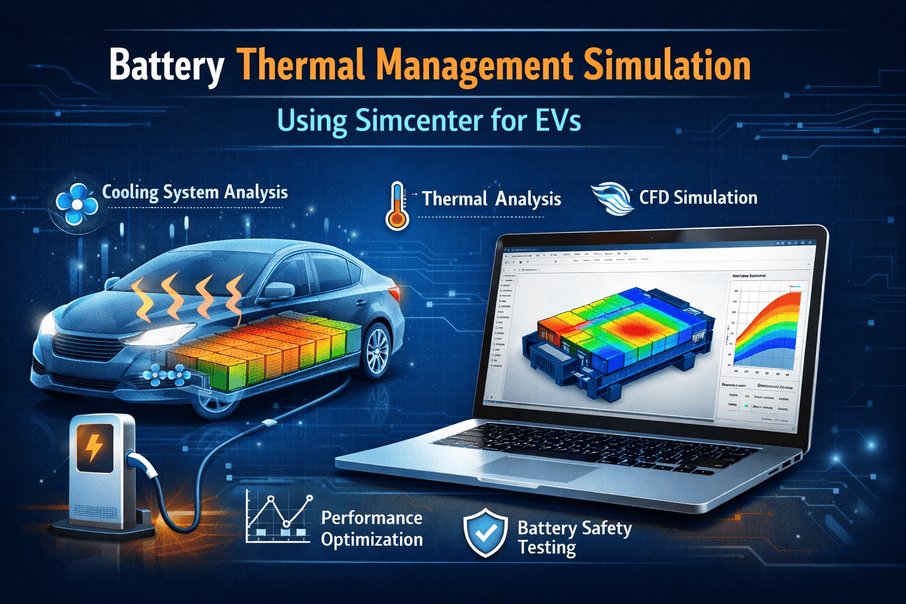
Electric vehicles live and die by their thermals. You can pack a chassis with the highest energy density cells available today. If you cannot reject the heat they generate during a 350kW fast charge, the pack will degrade. The vehicle will throttle power. It will frustrate the driver. We use battery thermal management simulation to map exactly how heat moves through a module long before a single physical prototype gets milled.
Building physical battery packs is expensive. Tearing them down because a center cell overheats is worse. We skip that trial-and-error phase entirely.
Why Battery Thermal Management Simulation Dictates EV Performance
Heat distribution inside a battery pack is never uniform. The center cells bake. The outer cells stay cool. A mere 3-degree Celsius temperature gradient across a module cuts the overall cycle life by 10 percent. We see this constantly when validating early-stage pack designs. Center cells trap heat because they have no direct path to the ambient environment. This imbalance drives uneven aging across the pack. You eventually end up with an EV range limited entirely by its weakest, hottest cell.
Running a precise electric vehicle battery cooling simulation exposes these dead zones. We feed Simcenter the specific drive cycle data. We input the exact coolant flow rates. The software shows us the thermal gradients across the busbars and cell tabs. This matters because a massive percentage of heat exits through the cell tabs. If your tab cooling strategy is flawed, the entire module suffers.
A solid EV battery heat management system does not just blast cold fluid through a cold plate. It balances the pressure drop across the cooling channels. If the pump has to work too hard to push the coolant, you drain the battery just trying to cool it.
Setting Up a Battery Thermal Management Simulation
The setup dictates the output. A proper Simcenter EV battery simulation requires accurate Open Circuit Voltage and internal resistance mapping. We do not guess these numbers. We characterize the physical cells first. We measure how the internal resistance spikes at sub-zero temperatures and drops when hot. We then build the 1D system model and link it directly to the 3D computational fluid dynamics environment.
Most battery thermal analysis software gives you a colorful heat map. Simcenter gives you transient response data coupled with electrochemical aging models. You can actually see the heat transfer coefficient drop as the coolant viscosity changes at lower temperatures. We use this data to size the coolant pumps correctly.
During a lithium-ion battery thermal simulation, the heat generation term is highly non-linear. The entropic heat coefficient flips its sign depending on the state of charge. When the battery is almost empty, it behaves differently from when it is full. We map this explicitly in our models to avoid nasty surprises during physical testing.
One of the most common issues we fix is flow maldistribution in the cold plates. Coolant takes the path of least resistance. The channels closest to the inlet get too much flow. The channels at the far end starve.
We change the channel geometry in the software. We add flow restrictors to the inlet headers. We run the simulation again. We repeat this until the flow is balanced within 5 percent across all channels. This ensures every cell gets the exact same cooling capacity.
Refining the Battery Thermal Management Simulation
You cannot look at the battery in isolation. Conducting a thermal simulation for electric vehicles requires accounting for the entire vehicle loop. The cabin cooling system often shares the same chiller circuit as the battery. If the driver turns the air conditioning on maximum during a fast charge on a hot day, the compressor has to split its capacity.
We model these exact edge cases. We define the control logic in Simcenter to prioritize battery cooling over cabin comfort when cell temperatures approach critical limits. The simulation tells us exactly how long it takes for the battery to hit the 45-degree Celsius derating threshold under these conditions.
We also model thermal runaway propagation. If one cell vents, we need to know if the adjacent cells will follow. We add insulation barriers between the cells in the CAD model. We run the transient thermal analysis to see if the barrier delays the heat transfer long enough for the vehicle safety systems to trigger. The results guide our material selection. Sometimes, a simple aerogel blanket between the modules is enough. Other times, we have to redesign the venting exhaust paths entirely to route the hot gases away from the high voltage contactors.
Simulations often fail because they assume ideal conditions. Real packs have manufacturing tolerances. Thermal interface materials have varying thicknesses. A gap pad might be compressed perfectly on one module but leave a tiny air gap on another due to stack-up tolerances. Air is a terrible conductor of heat.
We account for this by running sensitivity analyses. We intentionally degrade the thermal conductivity of the gap pad in our models to simulate a bad factory assembly. If the pack still survives, we know the design is safe. If it fails, we tighten the manufacturing tolerances or switch to a liquid-dispensed gap filler.
We do not write reports just to check a box. We provide actionable engineering directives. We tell our clients exactly which coolant channel needs to be wider. We specify exactly what the pump flow rate needs to be at different operating temperatures.
At CJ Tech, our focus is entirely on turning complex thermal data into manufacturing realities. We have spent years dialing in our simulation parameters against real-world test data. If your team is struggling with pack thermals, uneven cell aging, or high-pressure drops in your cooling loops, we can model the fix before you spend another dollar on physical prototypes.
Frequently Asked Questions
What data do you need to start a battery simulation?
We need the CAD geometry of the module, the cell internal resistance profile across different temperatures, the coolant properties, and the target drive cycles or fast charge profiles.
How long does a full transient thermal analysis take?
A basic steady-state flow analysis takes a few hours. A full transient drive cycle simulation coupled with electrochemistry can take a few days of compute time, depending on the mesh density.
Can Simcenter predict thermal runaway?
Yes. We use it to model the heat release from a failing cell and track how that heat propagates through the adjacent cells, busbars, and cooling structure to validate safety mitigation strategies.
Why is flow balancing so critical in cold plates?
If the flow is unbalanced, some cells run hotter than others. Hot cells degrade faster, increasing their internal resistance. This makes them generate even more heat, accelerating the failure of the entire pack.