
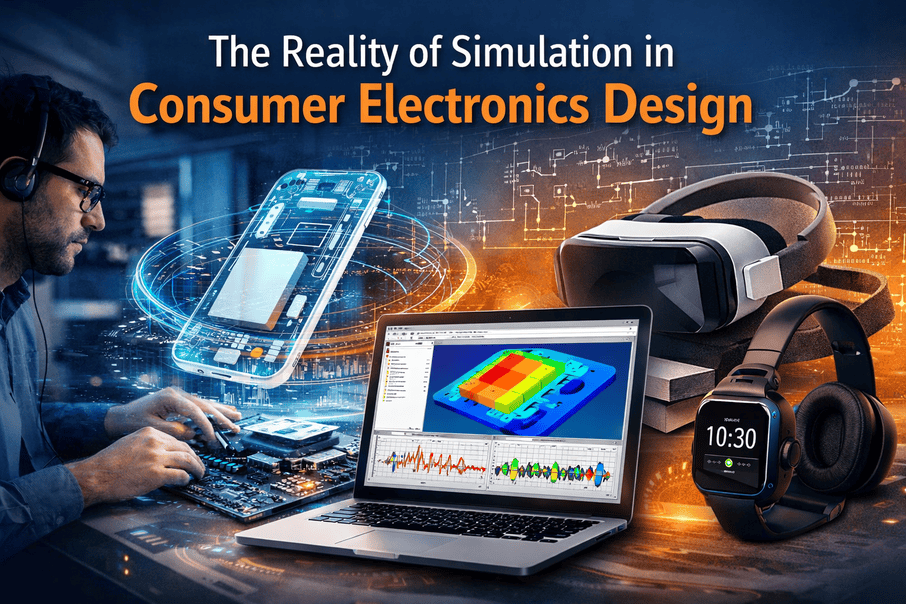
Hardware teams face a hard limit today. You pack a faster processor and a bigger battery into a thin glass case. Heat builds up fast. The battery swells. The logic board warps. We used to catch these failures during physical prototyping. That meant ordering custom parts, waiting three weeks for delivery, and melting them in a thermal chamber. That cycle is too slow for the current market.
This is where simulation in consumer electronics design changes our workflow. We build the device digitally first. We break it digitally. We test how a smartwatch survives a drop onto concrete. We see how a laptop hinge handles ten thousand open and close cycles. This lets us find the weak points before we ever cut a piece of metal.
Why We Rely on Simcenter for Electronics Design
Engineers need to know exactly what happens during sudden physical impacts. We rely on Simcenter for electronics design because it models these physical forces accurately. We map the stress distribution across the display glass and the internal aluminum brackets. If a specific tiny screw shears under the impact force, we see it red on the screen.
We can swap that aluminum bracket for a titanium one directly in the software. We ran the drop test again. This takes a few hours of computing time instead of weeks of waiting for a machine shop.
Fixing Heat Traps with Thermal Simulation for ElectroSIMnics
Processors throttle their speed when they get hot. Users notice the lag immediately. Managing that heat inside a sealed, waterproof enclosure is difficult. There is no active airflow. We apply thermal simulation for electronics to map the heat transfer. We locate the exact spot where heat pools near the battery pack.
We can then adjust the thickness of the graphite thermal pad. Sometimes we move the power management chip two millimeters to the left. These microscopic adjustments drop the surface temperature by a few degrees. That keeps the device comfortable to hold. We look at how heat spreads through the copper layers of the board itself. It is a constant puzzle of moving parts around to avoid creating a concentrated hot spot.
Locating Signal Noise Using PCB Simulation Tools
Modern circuit boards cram thousands of connections into a tiny footprint. Signals cross paths. Interference ruins transmission. We use PCB simulation tools to trace these high-speed signals. We look for crosstalk between the memory traces and the Wi-Fi antenna.
If the antenna signal degrades because a copper trace is routed too close, we change the path. We verify the fix in the software. We check the power delivery network. A sudden spike in power draw from the processor can cause a voltage drop that resets the whole system. We simulate these power spikes to ensure the capacitors are placed correctly to handle the load. The board works on the first physical manufacturing run.
Selecting Electronic Product Simulation Software
Teams need tools that handle multiple physical forces at once. A speaker vibrates loudly. That vibration causes fatigue on a nearby sensitive solder joint over time. Good electronic product simulation software calculates both the acoustic pressure and the mechanical stress simultaneously.
We check if the plastic casing degrades under continuous heat exposure. We simulate fluid dynamics for devices that need water resistance. We watch how water pressure pushes against the rubber seals at different depths. If the seal deforms, we change the channel geometry.
Integrating Product Design Simulation Software Daily
You have to connect your mechanical engineers with your electrical team. They usually work in silos. The electrical team changes a component size. The mechanical team needs to know immediately if it still fits in the casing without hitting the screen.
Using product design simulation software bridges that gap. We share one central digital model. Everyone sees the physical changes in real time. If an electrical engineer adds a taller capacitor, the mechanical engineer sees the interference immediately. They can adjust the housing design on the same day.
Tangible Electronics Engineering Simulation Benefits
The results show up directly in the project budget and timeline. We cut out multiple rounds of physical prototyping. We do not guess if a design works. We know it works under specific conditions.
| Development Phase | Traditional Method | Our Simulation Approach |
| Prototyping | Build five physical models, break them, order more parts. | Build one digital model. Test hundreds of material variations. |
| Heat Management | Thermal camera testing only after final assembly. | Identify hot spots before ordering the first circuit board. |
| Signal Integrity | Find noise issues during lab testing. Redesign the whole board. | Route traces perfectly the first time based on digital feedback. |
| Drop Testing | Smash expensive prototypes repeatedly. | Simulate impacts on different surfaces digitally. |
Here are the electronics engineering simulation benefits we actually track on our projects:
- Fewer scrap parts sitting in bins at the lab waiting for disposal.
- Identifying the exact failure point of a hinge mechanism after fifty thousand cycles.
- Shipping the final hardware on time because we did not have to redesign the motherboard at the last minute.
- Catching physical interference issues early.
Frequently Asked Questions
Does simulation replace physical testing entirely?
No. We still build final physical prototypes to validate the digital models. Regulatory agencies require real physical test data for certification. We just do it once instead of five times.
Is it expensive to run these digital tests?
High-end software licenses do cost real money. Server compute time also costs money. But ordering a custom batch of faulty printed circuit boards costs much more. It saves your company a significant amount of money in the long run.
How does simulation improve the battery life of consumer electronics? Heat is a major factor in battery degradation and inefficient power consumption. By using thermal simulation, we can design better cooling paths that keep the battery within its optimal temperature range, which directly extends its daily runtime and overall lifespan.
What role does simulation play in the miniaturization of devices? As devices get thinner, components are packed closer together, increasing the risk of signal interference and overheating. Simulation allows us to test these tight configurations in a virtual space, ensuring that “cramming” more tech into a smaller frame doesn’t compromise the safety or performance of the product.
Hardware development is unforgiving. You cannot push a software patch over the air to fix a cracked screen or a fried battery. We use these modeling tools to find the physical breaking points early. This data guides our daily engineering decisions. We remove the expensive guesswork from the equation. At CJTech, we make sure your device survives the real world before it ever leaves the digital one.