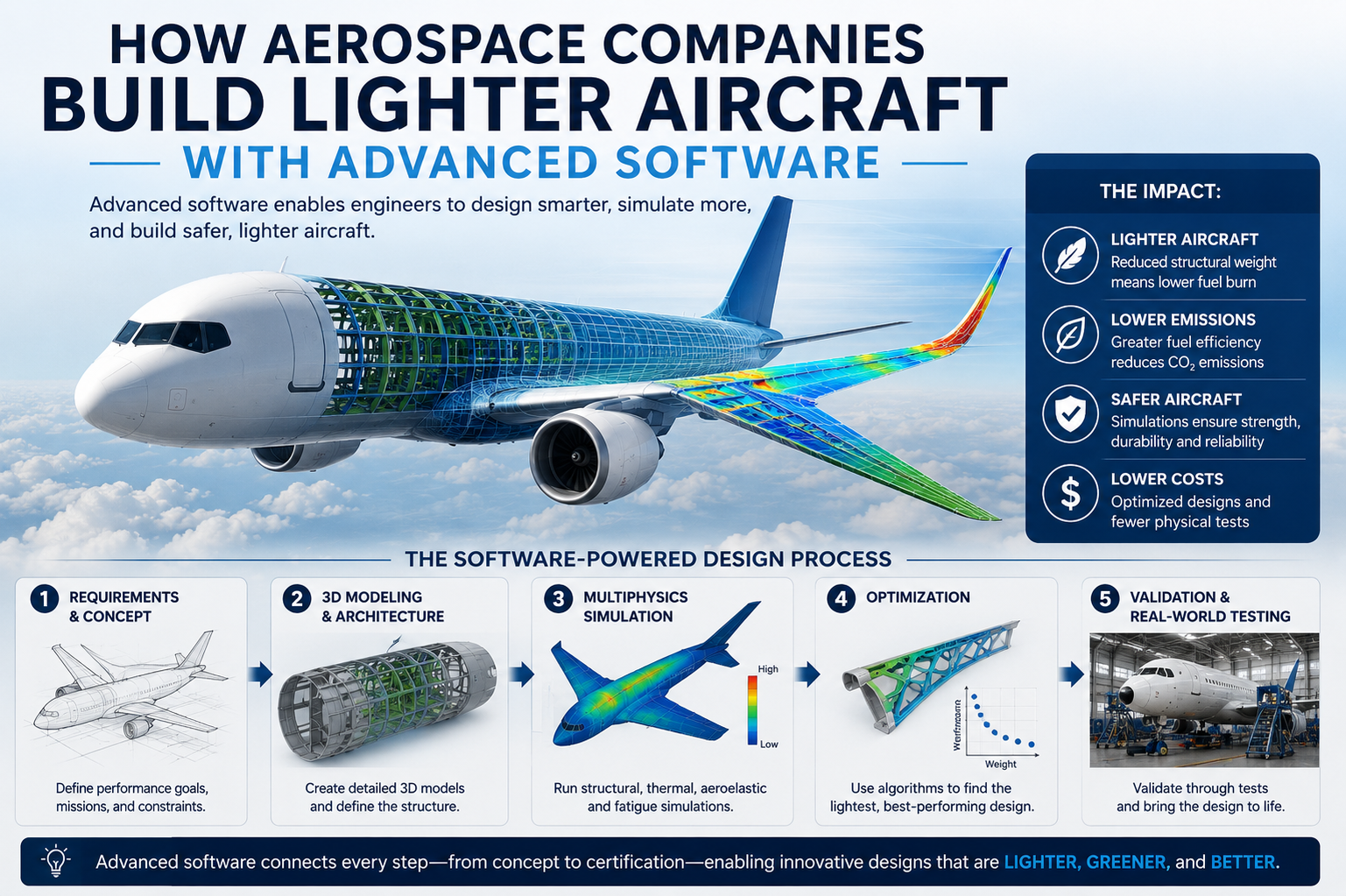
Aerospace engineering revolves around a single punishing metric. Weight. Every extra kilogram costs fuel and reduces payload capacity. Manufacturers are under significant pressure from airlines to produce highly efficient airframes. Regulatory bodies demand proof that these lighter structures can survive decades of turbulence, hard landings, and temperature extremes.
We watch engineering teams struggle with outdated validation methods. Physical testing remains slow and incredibly expensive. Building a test wing box takes months of fabrication. Breaking it in a stress lab takes seconds. CJ Tech helps aviation companies escape this bottleneck. We see the direct impact of shifting from physical prototyping to digital validation. Companies iterate faster and discover structural flaws before cutting any metal. Here is exactly how the aviation sector applies modern solvers to construct the next generation of flight.
Speeding Up Certification With Altair Hyperworks
Regulatory agencies require mountains of data before an aircraft carries passengers. Historically, teams generated this data through endless physical tests. The industry now leans heavily into certification by analysis. Engineers use Altair Hyperworks to handle the complex physics of flight loads and prove structural integrity digitally.
Aircraft experience aerodynamic pressures that change by the millisecond. Engineers map these fluid dynamics directly onto the structural mesh. They visualize exactly how a radome or a wing leading edge behaves under severe wind loads.
This digital shift achieves specific, measurable outcomes:
- Reduces the number of physical prototypes required prior to flight testing.
- Identifies stress concentrations around thousands of individual rivets.
- Automates the generation of standardized stress reports for regulatory bodies.
Manual report creation drains engineering hours. Automating this process frees analysts to actually interpret the data. Altair HyperWorks provides an environment where modeling, solving, and reporting happen in a single continuous workflow.
Driving Weight Reduction Through topology optimization in aerospace
Finding safe places to shave off material is a tedious process if done manually. Engineers rely on topology optimization in aerospace to reveal load paths humans typically miss. You define the design space and apply the loads. The software carves away the dead weight.
The resulting components often look organic and bone-like. For example, outboard wing box ribs require maximum stiffness to handle bending and twisting forces. OptiStruct removes material from the rib web while leaving a lattice of structural supports. The part maintains its exact strength requirements but weighs significantly less.
Engineers also run failsafe optimizations. Aircraft structures need to withstand the failure of neighboring components. The software evaluates several damage scenarios at the same time. It outputs a single geometric design that holds together even when the surrounding parts break.
Replacing Guesswork With Accurate CAE Simulation Tools
Landing gear fittings endure chaotic, multi-directional stress. Adding extra metal just to be safe ruins aircraft weight targets. Engineering teams deploy CAE simulation tools to measure exact stress limits instead of relying on conservative estimates.
Compute clusters handle the heavy calculations. A team runs five hundred design variations overnight. They check the stress plots the next day and finalize the geometry by noon.
Fatigue life prediction traditionally relied on massive safety buffers. Constant vibration and extreme thermal cycling degrade parts over time. Simulation software tests these exact operational conditions digitally. The component gets engineered to last its required lifespan. Nothing more.
Managing Composites Using Altair Simulation Tools
Carbon fiber acts differently than traditional aluminum. Laminates need distinct mathematical models to predict structural failure. Altair simulation tools calculate exactly what happens inside a composite layup at the microscopic level.
The software finds the optimal ply shape. It defines the stacking sequence for high-stress areas. Manufacturing constraints are built directly into the analysis phase.
- Identify the exact ply count needed to stop buckling.
- Test honeycomb cores against shear forces.
- Spot internal delamination risks before the component reaches the autoclave.
The structural behavior of the finished composite becomes clear early in development. Engineering teams sign off on designs without padding them with extra weight just for peace of mind.
Integrating Additive Manufacturing and engineering design optimization
3D printing allows manufacturers to produce complex geometries that traditional CNC machines cannot cut. This pairs perfectly with algorithmic design. However, 3D printing has strict physical rules. You cannot print certain overhangs without support structures.
This is where engineering design optimization links digital ideas with manufacturing realities. The software aligns the optimized geometry with the constraints of the 3D printer. It prevents the creation of a structurally perfect part that collapses during the printing process.
Aerospace companies now print titanium brackets that weigh 60 percent less than their milled predecessors. Engineering design optimization ensures these organic shapes survive the harsh vibrations of a jet engine. The development cycle shrinks drastically. Components move from initial concept to the print bed in a matter of weeks.
Frequently Asked Questions
What makes Altair Hyperworks different from legacy solvers?
Altair Hyperworks integrates geometry editing, analysis, and visualization into a single unified platform. Engineers do not waste time translating files between disconnected programs. It manages everything from basic linear statics to highly complex multiphysics simulations in one place.
Are CAE simulation tools difficult to deploy with existing CAD data?
Modern platforms feature highly open architectures. They read natively from dozens of different CAD systems. Your engineering team imports existing geometry directly into the solver environment without having to rebuild the models from scratch.
Why is engineering design optimization necessary for modern aviation?
The industry demands massive efficiency gains. Engineers simply cannot achieve these targets through manual calculations and trial runs. Algorithmic optimization explores thousands of structural variations in hours to locate the absolute best configuration for the given loads.
Building the Next Generation of Flight
Aerospace schedules are unforgiving. Manufacturers have to strip mass out of components while hitting strict delivery dates, making physical prototyping far too slow. Computational solvers run the math required to hit these specific targets. We understand these tight constraints at CJ Tech. Our team deploys the analysis software you need to find stress failures before production begins. Partner with us to upgrade your structural validation workflow. You will produce reliable aircraft and stop losing time to failed physical tests.