
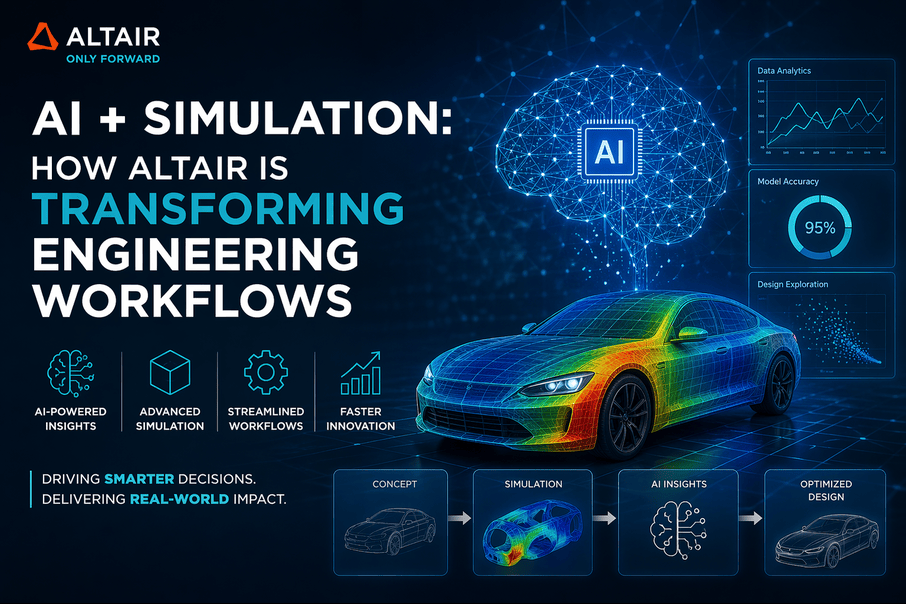
Engineering teams waste too much time waiting for solvers. You build a massive 3D model. You set up the mesh. You run the analysis. Then you wait three days to find out your thermal thresholds failed. This old cycle kills product timelines.
We fix this bottleneck by merging machine learning directly into the CAD and CAE environments. The math has changed. You no longer need to run a full physics solver for every minor geometry tweak. You train a predictive model on your historical project data. You get answers in seconds.
The Real Impact of AI in Engineering Simulation
Using Altair simulation software shifts how a design team operates daily. Traditional solvers rely on heavy finite element analysis. They calculate the physics at every single node. This takes massive compute power. It forces engineers to limit how many design variations they actually test.
When we implement these systems for clients, we look at their past projects. Most manufacturing companies sit on terabytes of old, ignored simulation data. We feed that raw data into Altair PhysicsAI. The system learns the direct relationship between the physical shape of a part and its structural or thermal performance.
Instead of running a new 10-hour crash simulation for a slightly modified chassis, the trained model predicts the stress distribution instantly. You see the outcome immediately on your screen. This level of simulation and AI integration changes the daily routine:
- You test fifty variations of a bracket before lunch.
- Failing designs become obvious immediately.
- Your traditional solver only sees the final candidate for formal validation.
The hardware utilization drops. The engineering output doubles.
Overcoming Bottlenecks with AI in engineering simulation
Data preparation usually stalls engineering workflow automation. Cleaning raw geometry and setting up meshes historically required severe manual effort. Engineers spend hours clicking edges, fixing bad surfaces, and defining boundaries.
Altair HyperWorks AI features eliminate the bulk of this manual clicking. The software recognizes parts automatically based on shape. Think about what this means for setup:
- Standard bolt holes get recognized instantly.
- The system meshes a flange without explicit instructions from your team.
- You stop defining boundaries manually for every single iteration.
This matters heavily because model setup time often exceeds actual compute time on complex assemblies. We routinely cut preparation time by 60 percent using these automated classification tools. The engineers stop doing repetitive administrative software tasks. They go back to doing actual engineering.
You avoid strict parametric limitations. Standard optimization tools force you into rigid bounding boxes. AI driven simulation tools ignore those constraints. They evaluate entirely new shapes based strictly on the physics goals you define. The software suggests a physical form you probably never considered. You end up with a lighter part that costs less to manufacture.
Building Smarter Systems Using AI in engineering simulation
System-level testing presents a completely different computing challenge. You cannot easily couple a highly detailed 3D fluid dynamics model with a complex mechanical assembly. The computing load crashes most local clusters. The run times become impossible to manage.
We use romAI to solve this exact issue. The software takes a heavy 3D simulation and compresses it into a highly efficient 1D reduced-order model.
You lose a tiny fraction of visual fidelity. You gain an enormous amount of speed.
This is how smart engineering design tools operate today. You drop that lightweight 1D model into a larger system-level simulation. You test how a specific cooling pump affects the overall battery temperature over a full drive cycle. Doing this with full 3D models takes weeks of cluster time. With reduced-order models, it takes minutes.
You identify system-level failures early in the development cycle. We see clients catch thermal propagation issues in week two of a project instead of week twenty. Fixing a mistake in week two costs nothing. Fixing it in week twenty delays the launch and burns the budget.
Integrating these advanced tools changes the fundamental structure of a hardware program. You stop relying on physical prototypes to find your mistakes. We see teams overhaul their timelines because:
- They simulate the entire manufacturing process up front.
- Structural integrity gets verified against historical failure data.
- Everything happens before cutting a single piece of steel.
Implementing these workflows requires more than just buying a software license. You need clean historical data. You need proper model training protocols. If you feed bad data into the algorithms, you get confident but incorrect predictions. We help manufacturing teams structure their data libraries to feed these systems correctly. Our engineers at CJ Tech configure the specific Altair tools to match your unique product development cycle. We integrate the predictive models directly into your daily routine. Your design team stops waiting for computational results and starts making better, faster engineering decisions.
Frequently Asked Questions
How much historical data do I need to train the models?
You do not need millions of files. Most models generate accurate predictions with a few hundred past simulations. We evaluate your existing data pool to determine if it covers enough geometric variation to be useful for training.
Does AI replace traditional physics solvers entirely?
No. You still run traditional solvers for final validation and official certification. The AI handles the heavy computational lifting during the design exploration phase. It helps you find the right design quickly so you only run the slow solver once.
How does the software handle highly complex assemblies?
You don’t want your team meshing a thousand brackets and bolts by hand. Altair handles volume through shape recognition. The system learns your standard components from past projects. It applies the correct mesh rules across massive assemblies automatically. You spend your time reviewing the results instead of prepping the model.
Is it difficult to adopt these tools without data scientists on staff?
You do not need a machine learning expert on payroll. We deploy these systems specifically for mechanical and structural engineers. There is no coding or scripting required on your end. The interface lets you point at your historical data and define your target metrics visually. We handle the backend configuration, so your team can focus entirely on the engineering.
Can we use our existing cloud hardware for this?
Yes. The platform scales across on-premise clusters and major cloud providers. You use your existing compute resources efficiently because predictive models require less processing power than traditional full-scale simulation runs.