

Modern design organizations operate in a highly competitive environment that places emphasis on high performance and compliance requirements .Defense systems need to be designed, manufactured, and upgraded with seamless precision. Be it with aircraft or naval platforms or weapon systems. To attain this level of efficiency, traditional engineering tools alone won’t work. It requires across the entire lifecycle a unified digital backbone connecting people, processes, and technologies.
This is where Siemens Teamcenter PLM comes into the picture. Defense organizations can by integrating it with enterprise systems like ERP, Manufacturing Platforms, and Advanced Simulation Tools, accelerate modernization. They can also reduce risks and enhance mission readiness.
HOW TEAMCENTER PLM ENABLES DEFENSE DIGITAL TRANSFORMATION?
Siemens Teamcenter PLM is designed to manage products’ entire lifecycle. That is, from concept and design to manufacturing, deployment, and maintenance.
KEY CAPABILITEIS
- Configuration & variant management.
- Change and workflow management.
- Digital thread and digital twin enablement.
- Engineering BOM (EBOM) and MBOM alignment.
- Product data management (PDM),
- Requirements management.
Teamcenter when combined with ERP and Simulation platforms becomes for defense modernization a powerful engine.
INTEGRATING TEAMCENTER PLM WITH ERP & SIMULATION TOOLS
Here is how it helps defense modernization.
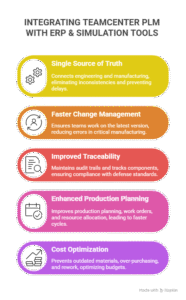
SINGLE SOURCE OF TRUTH ACROSS ENGINEERING & MANUFACTURING
Engineers build designs in Teamcenter. Manufacturing teams work in ERP.
When these systems are connected,
- Engineering BOMs automatically sync with manufacturing BOMs.
- Procurement receives accurate component data.
- Inventory aligns with real-time design updates,
They help to
- Eliminate inconsistencies; and
- Prevent costly production delays
FASTER, ERROR-FREE CHANGE MANAGEMENT
Defense systems undergo constant upgrades.
Integration ensures that:
- Engineering change notices (ECNs) from Teamcenter flow directly into ERP.
- Manufacturing and procurement teams always work on latest version.
- Old components, obsolete parts, and design modifications are tracked globally.
This helps reduce in critical manufacturing the risk of errors.
IMPROVED TRACEABILITY AND COMPLIANCE
Detailed traceability is required for compliance with defense standards. This includes standards like AS9100; MIL-SPEC, ISO9001.
Integration helps:
- Maintain for certification audit trails.
- Track every component from design to deployment.
- Ensure the right parts enter production.
Such traceability is vital for mission-readiness.
ENHANCED PRODUCTION PLANNING & SCHEDULING
ERP integration with Teamcenter helps ensure:
- Accurate BOMs improve production planning;
- Work orders reflect latest engineering updates; and
- Resource allocation becomes more efficient.
This leads to
- Faster manufacturing cycles; and
- Improved supply chain coordination.
COST-OPTIMIZATION
Accurate engineering data prevents:
- Use of outdated materials.
- Over-purchasing.
- Production rework.
Integrated PLM and ERP systems help defense organizations optimize budgets. This is essential in modernizing equipment within limited government allocations.
INTEGRATIING TEAMCENTER PLM WITH SIMULATION TOOLS
Modern defense systems count a lot on simulation for:
- Thermal and fluid dynamics.
- Structural analysis.
- Electromagnetic behavior.
- Fatigue and crash analysis.
- Systems engineering.
- Mission simulations.
These simulations are often performed on tools like
- Simcenter ANSYS;
- MATLAB/Simulink; or
- Other CAE platforms.
ENGINEERS ACCESS ALL MODELS FROM ONE PLATFORM
Simulation engineers can easily access:
- CAD Models.
- Material Libraries.
- Load cases.
- Previous simulation results.
There will be no need for searching through emails or unorganized folders.
VERSION CONTROL FOR CAE MODELS & RESULTS
Teamcenter automates:
- Revision management.
- Update notifications.
- Workflow approvals.
- Data traceability.
This is vital for defense applications where multiple teams work on evolving system designs.
CLOSED-LOOP DIGITAL TWIN DEVELOPMENT
Digital twin enables defense organizations to:
- Optimize performance;
- Predict failures; and
- Improve mission reliability.
Integration allows simulation results to directly influence design decisions. They then create a closed feedback loop.
FASTER VALIDATION AND VERIFICATION CYCLES
Traditional defense testing is expensive. They are also time-consuming.
Integrated simulation with Teamcenter allows:
- Automated test management.
- Modern-based engineering workflows.
- Virtual validation.
This reduces physical testing needs. They in turn save time and costs.
COLLABORATION ACROSS ENGINEERING DISCIPLINES
Mechanical, electrical, software, and systems engineers all work in interconnected frameworks.
Teamcenter assists them by supporting:
- Multi-domain data sharing.
- Model-based definition (MBD).
- Interdisciplinary workflows.
- Systems engineering (MBEE).
These help to increase cross-functional efficiency.
CONCLUSION
Teamcenter PLM when integrated with ERP and Simulation Platforms provides a powerful solution. They help build a strong, connected, and intelligent ecosystem.
This will
- Eliminate data silos;
- Accelerate engineering;
- Enhance decision-making; and
- Ensure consistent quality across the product lifecycle.
As a result, defense organizations benefit from
- Faster modernization;
- Greater system reliability;
- Lower lifecycle costs; and
- Improved mission readiness,
Defense organizations can by harnessing CJ Tech’s proficiency in Siemens Teamcenter PLM in a unified digital thread drive smarter integration, connecting design, simulation, manufacturing, and sustainment.
FAQs
1. How will integrating Teamcenter PLM with ERP systems benefit defense programs?
Integrating Teamcenter PLM with ERP systems creates a unified digital ecosystem. An ecosystem where engineering and manufacturing data flow seamlessly.
BENEFITS
- Faster procurement and production planning.
- Real-time synchronization of BOMs (Engineering VS Manufacturing BOM).
- Reduced rework and errors due to consistent data.
- Better cost estimation and resource allocation.
- Enhanced traceability for defense compliance and audits.
This integration ensures defense programs graduate from design to deployment with higher accuracy and speed.
2. Is it possible to integrate Siemens Teamcenter PLM with multiple ERP platforms used in defense manufacturing?
Yes, it is possible. Siemens Teamcenter PLM supports standardized integration frameworks and APIs. They drive connection to multiple ERPs like SAP, Oracle, and defense-specific ERP systems.
3. Does the integration of PLM Software with ERP reduce program delays in defense projects?
Yes. Integration between PLM Software and ERP eliminates siloed data and manual data entry. They also eliminate design-to-manufacturing discrepancies’.
This leads to:
- Automatic updates change management.
- Faster engineering change management.
- Higher accuracy across departments.
Together these tools reduce overall project delays. They also help drive improved mission readiness.
4. How does Teamcenter help manage complex defense product configuration?
Defense systems like aircraft, naval vessels, and vehicles have highly complex configurations.
Teamcenter PLM enables:
- Multi-level configurations and variant management.
- Tracking of each change across the lifecycle.
- Configuration audits and compliance reporting.
This ensures every version of a defense asset is fully documented and traceable.
5. Can Teamcenter support digital twins for defense equipment?
Yes, it can. Siemens Teamcenter PLM plays a prime role. It helps to build and manage digital twins by linking real-world performance data with digital models.