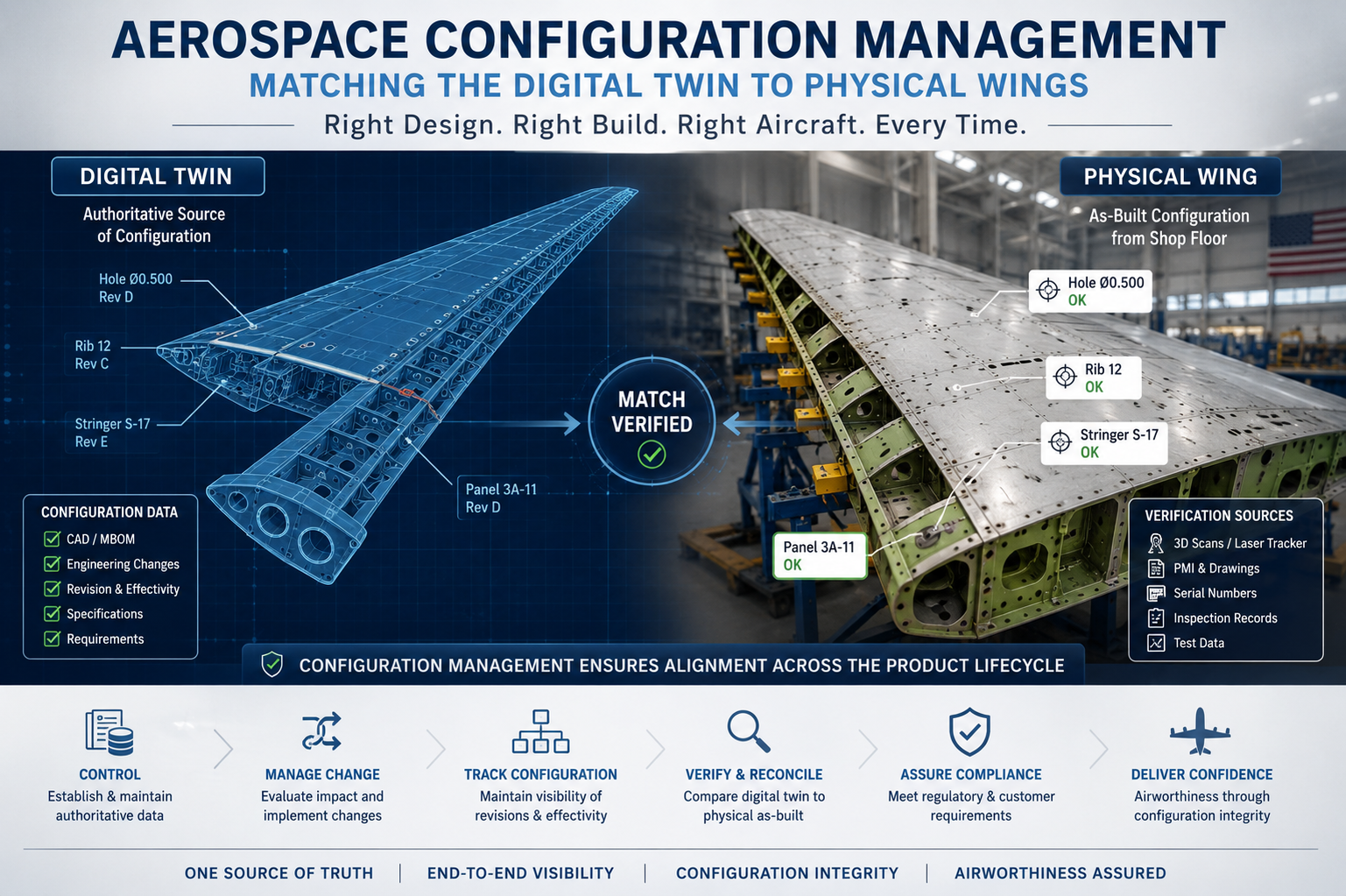
An aircraft parked on a runway is four million individual parts. Each part has a serial number, a manufacturing batch, and a stress-test signature. If an assembly worker swaps a bracket on the line to make it fit, the digital blueprints must reflect that swap immediately. When physical parts do not match their digital blueprints, regulatory bodies ground the fleet. This is configuration management. It is not administrative paperwork; it is a safety requirement.
We work with aerospace teams at CJ Tech to build systems that automate these tracking loops. We see where the data breaks down between the design office and the assembly line.
Tracking Aircraft Complexity: Configuration Management and Siemens Teamcenter
Aerospace projects run for decades. A commercial cell designed today will likely fly for forty years, undergoing hundreds of retrofits, component swaps, and structural repairs. Tracking this across multiple factory floors gets messy.
This process gets complicated when deploying Siemens Teamcenter across multiple design centers. When the manufacturing floor swaps a fastener to keep production moving, and the design office remains unaware, the digital twin breaks. Software alone does not fix broken workflows.
Using an organized database prevents these alignment errors. It ties change records directly to the physical serial number of the aircraft. When we work with aerospace clients, we emphasize that configuration management must connect directly to active engineering work. It cannot be an afterthought managed in isolated spreadsheets. We use Siemens Teamcenter to tie these change records directly to the active engineering CAD models, preventing modified parts from being installed without engineering sign-off.
Managing Physical and Digital Assets with Siemens Teamcenter PLM software
Airlines do not buy standard planes. They want custom seating layouts. They demand specific avionics setups and modified galleys. This leaves manufacturers building dozens of variations of the exact same airframe, clogging up the floor.
We use Siemens Teamcenter PLM software to handle this chaos. It bridges the gap between custom sales orders and the engineering department. Instead of throwing disconnected Excel sheets over the wall, teams work on a single, multi-view Bill of Materials (BOM).
Here is what happens when you sync this up on the floor:
- When design engineers change a bolt hole on the drawing, the Manufacturing BOM updates the drill machine coordinates immediately. No one has to go down there with a red pen.
- Weight tracking. Swapping aluminum brackets for carbon composites updates the center of gravity calculation instantly, rather than waiting for a weekly design review.
- If a landing gear pin cracks, we track the issue back to the specific heat-treat batch and forge mold in seconds.
If you run these systems on manual entry, you fail. A mismatched part number sits unnoticed in a warehouse until someone tries to bolt it onto a wing spar, halting the entire line.
Establishing Baseline Controls with Siemens Teamcenter PLM
A design baseline is a hard freeze. When you prepare a fuselage section for physical testing, engineers cannot make unofficial tweaks to the skin thickness. The physical unit under test must match the engineering baseline exactly.
Using Siemens Teamcenter PLM helps lock these configurations at major engineering milestones. Once a design phase reaches a milestone, the baseline is locked. Any subsequent change requires a formal engineering change order.
This systematic control keeps engineering math aligned with the actual physical test assets. When a change is proposed, the system performs an impact analysis, showing exactly which structural drawings, tooling fixtures, and test plans are affected before anyone approves the change. Integrating this control into the core design cycle requires safety officers, stress engineers, and manufacturing leads to sign off before a baseline is unlocked.
Solving Traceability Challenges with Siemens PLM Software Teamcenter
During an audit, validation is everything. If a civil aviation inspector asks for the engineering history of a specific landing gear assembly, the manufacturer must produce it immediately.
We rely on Siemens PLM Software Teamcenter to capture complete design and manufacturing histories. If a field technician reports a crack in a bracket, the engineering record must show:
- The raw material batch used to manufacture that specific bracket.
- The engineering change order that altered the bracket thickness.
- The specific stress analysis reports filed to justify the revision.
Having this information in a unified system reduces audit preparation times from weeks to minutes. It protects the manufacturer from liability and helps identify quality issues before they turn into major safety concerns. Our integration of this system keeps safety and engineering records linked to physical parts through every overhaul.
FAQs
What is the primary benefit of Siemens Teamcenter PLM software in aerospace configuration management?
It stops manufacturing from building outdated revisions. When you change a bracket bolt-hole diameter in CAD, the shop floor finds out instantly. They do not waste hours trying to force a physical pin into the wrong size hole because they were working off a stale blueprint printed three days ago.
How does Siemens Teamcenter PLM handle physical versus digital mockups?
By tying CAD configurations to physical tail numbers. You do not manage a generic aircraft; you manage N142CJ. Every repair, structural change, or custom galley layout is logged directly to that specific tail’s digital record so you know exactly what is actually flying.
Can Siemens PLM Software Teamcenter manage compliance requirements like AS9100?
Yes, because it leaves a digital paper trail. If an FAA auditor asks who approved a wing skin modification, you query the serial number. The system pulls up the signatures, stress logs, and material certs in under two minutes instead of your team digging through metal filing cabinets.
Closing Thoughts
Managing thousands of design variations across decades of flight is a massive control challenge. Our team at CJ Tech has spent years implementing these PLM environments for defense and commercial aerospace builders. We construct the automated change workflows, clean up legacy BOM structures, and integrate design data directly with factory floors. If your engineering changes are breaking down between the office and the shop, contact CJ Tech to discuss how we can bring control back to your assembly line.