
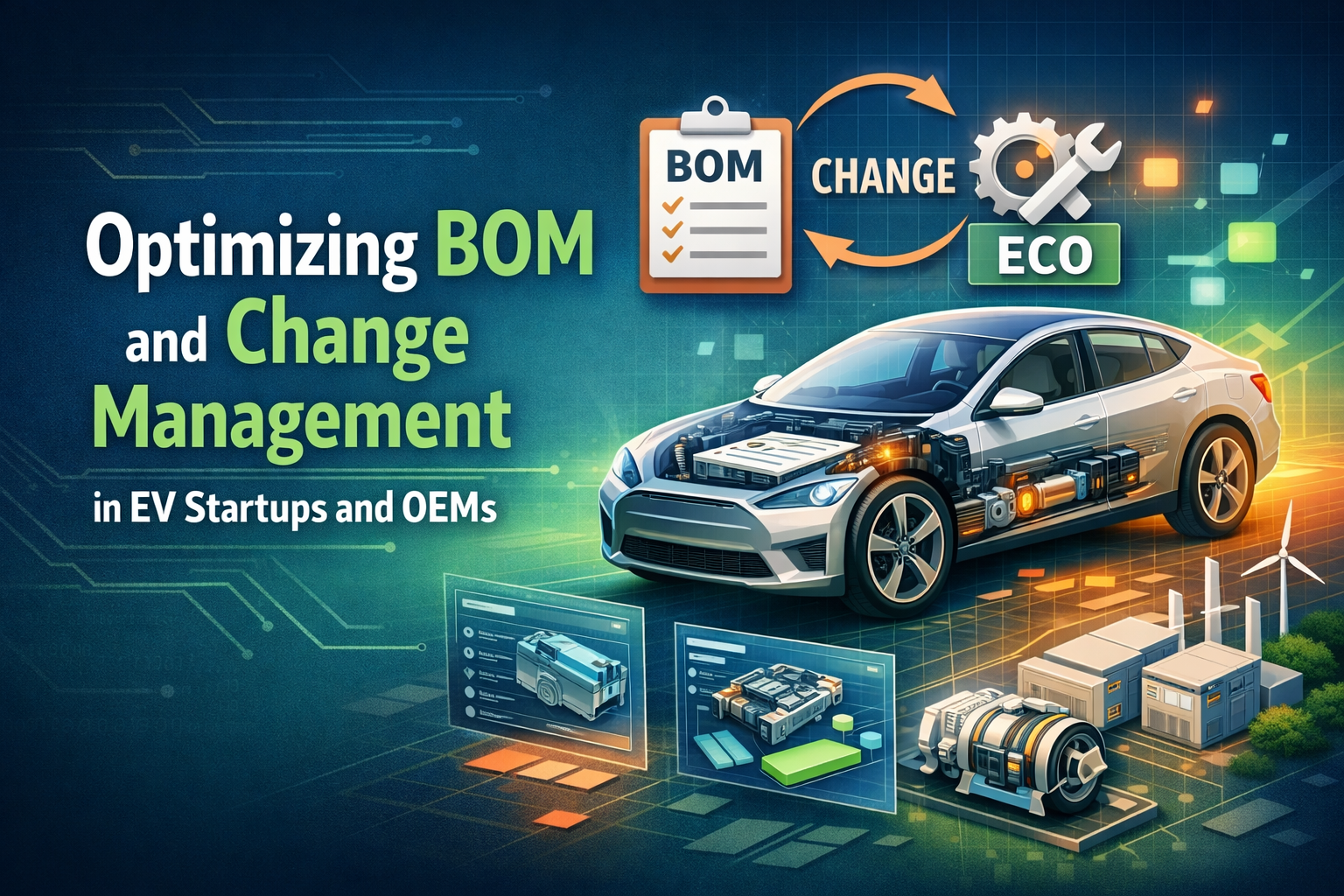
EV startups burn through capital when engineering errors survive until the physical prototype phase. A modern vehicle is a mess of high-voltage electronics, cooling circuits, and millions of lines of code. When these domains are siloed, the Bill of Materials (BOM) becomes a liability. TEAMCENTER unifies these data sets into a single source of truth, preventing the data fragmentation that kills speed.
The battery pack isn’t a static part. It is a live data set changing daily during the prototyping phase. If electrical engineers use a different version than the structural team, physical testing will fail. This lack of synchronization stops prototypes from ever becoming production vehicles. Success requires a system that manages these dependencies in real time.
The Multi-Domain BOM Challenge
Optimizing an EV BOM requires more than a list of parts. It requires an integrated approach to engineering, manufacturing, and service data. Software updates can shift hardware requirements in a single afternoon. SIEMENS TEAMCENTER manages these configurations across every iteration. Without it, you risk ordering a thousand wiring harnesses that do not fit the final chassis design.
As per NITI Aayog, EV-specific components account for 55-65% of the total cost of an electric vehicle in India. This massive concentration of value in a few core systems means that a single BOM error is not just a minor delay. It is a direct threat to the majority of your capital investment. Efficiency happens when the digital model matches the reality on the shop floor. This integration must extend to the software layer, ensuring that the firmware version is validated against the hardware revision before the first assembly begins.
Realities of Change Management
Change management usually breaks down when communication is manual. Imagine a bracket redesign that shifts a harness by five millimeters. If the thermal lead isn’t in the loop, that harness ends up too close to a heat source. The failure doesn’t happen on the CAD screen; it happens in a vehicle during high-voltage charging. These visibility gaps are what cause late-stage engineering changes that destroy margins. TEAMCENTER forces a closed-loop process. It ensures a modification cannot move forward until every affected domain signs off. It removes the “I thought you knew” excuse from the engineering workflow.
Spreadsheets are a liability in high-stakes engineering. They lead to ghost data where drawings on the floor are out of sync with the master model. You end up with crates of scrapped components because the shop floor built revision B while engineering had already moved to revision D. By the time the mismatch is flagged, the capital loss is already permanent.
| Process Metric | Manual Spreadsheet Tracking | Siemens Teamcenter Integration |
| Data Integrity | Prone to human error | Automated synchronization |
| Change Transparency | Siloed and delayed | Real-time enterprise visibility |
| Audit Trails | Manual and often incomplete | Automated revision history |
| Time to Market | Extended by rework | Accelerated via digital validation |
High-Volume Production and Scaling
Legacy OEMs entering the EV market are often hindered by their own history. They have vast amounts of data trapped in disconnected platforms that cannot process modern electronic requirements. This technical debt creates a barrier between mechanical heritage and new software demands. Deploying TeamCenter PLM at this stage is a necessity for data migration. It forces a unified structure across departments that have spent decades working in isolation.
Startups have the opposite problem. They have the technology but lack process discipline. They treat the part lifecycle as an afterthought. As production ramps up, the sheer volume of engineering change orders (ECOs) often leads to a total process breakdown. Implementing TeamCenter PLM before the first production run stops this administrative rot. It allows a small team to manage complex data with the rigor of a global manufacturer without losing their agility.
- Configuration Management: Run diverse vehicle variants on one line while ensuring part compatibility is verified automatically.
- Global Supply Chain: Share 3D specifications with vendors to avoid the cost of parts that do not fit.
- Regulatory Compliance: Capture the documentation required for safety standards throughout the design phase.
- Collision Detection: Use digital mockups to find interference between the battery pack and the chassis before ordering expensive molds.
The Cost of Digital Inconsistency
The financial consequence of poor data management is usually hidden in the rework column of the balance sheet. When engineers spend half their day hunting for the latest version of a file, innovation stops. High-quality teamcenter software is an investment in engineering hours. It returns that time to the design team, allowing for more cycles of optimization before the design is frozen.
A broken change process leads to recalls. In the EV industry, a recall related to battery safety or software glitches can bankrupt a young company. The ability to track every part back to its original design requirement is a safety mandate. Using TeamCenter PLM ensures that every change is documented, tested, and verified against the original safety goals of the vehicle program.
Strategic Implementation
Choosing a platform is only the first step. Success depends on how the workflows are mapped to the physical manufacturing process. If the digital system is too rigid, engineers will find workarounds. If it is too loose, the data becomes unreliable. SIEMENS TEAMCENTER is designed to be configured around the specific needs of the automotive lifecycle.
The goal of any TEAMCENTER software deployment is to make the data invisible. It should be there when the engineer needs it, without requiring a manual search. When the BOM and Change Management processes are optimized, the transition from design to delivery becomes a smooth pipeline.
Conclusion
Speed is the only currency in the EV market. Winners are defined by their ability to manage technical complexity without sacrificing the timeline. CJTech provides the implementation depth to ensure TEAMCENTER handles the data burden, freeing your engineers to focus on vehicle performance. Transitioning to SIEMENS TEAMCENTER is a strategic move toward mass production. Global leaders rely on TEAMCENTER software to bridge the gap between a digital mockup and a road-ready product.