Are you constantly adjusting feeds and speeds at the machine console because your post-processor output was wrong? That is a daily issue on the shop floor. When an operator hits cycle start and holds their breath, your process is broken.
MSME manufacturing relies on predictable outcomes to maintain margins. Yet many shops run on disjointed tools that force operators to second-guess the code.
Why do small machine shops lose margin on complex multi-axis parts? They rely on legacy systems that cannot interpret modern design intent. The resulting G-code requires manual edits at the controller. Manual edits consume spindle time and introduce human error directly at the cutting tool.
How do job shops handle undocumented design changes? They usually find out at inspection when a finished part fails QA. You cut the part exactly to the original print, but the customer emailed a revised file that got stuck in engineering. An integrated system prevents this disconnect entirely. The 3D model updates, the toolpath breaks immediately, and the programmer gets a clear notification to regenerate the paths before anything gets loaded into the machine.
The problem with generic CAD CAM software in the machine shop
You receive a STEP file from a new customer. It features tight tolerances on a complex 3D surface. You import it into your current system. The translation breaks several faces. Now your programmer spends two hours fixing basic geometry before they can even think about selecting a tool or defining a boundary.
Standard CAD CAM software often treats design and machining as completely isolated events. When the customer sends a revision, you start the programming process entirely over. There is no associativity linking the original geometry to your machining operations. You lose an afternoon reprogramming a part you already had running successfully.
Feature recognition is another common failure point. Why do programmers waste hours clicking individual holes to define drill cycles? Because basic software lacks automated recognition. You want a system that identifies holes, pockets, and slots automatically, applying the correct machining strategy based on your shop’s established standards. You program a 50-hole plate in seconds instead of manually selecting every edge.
How Solid Edge CAM for MSMEs changes the daily routine
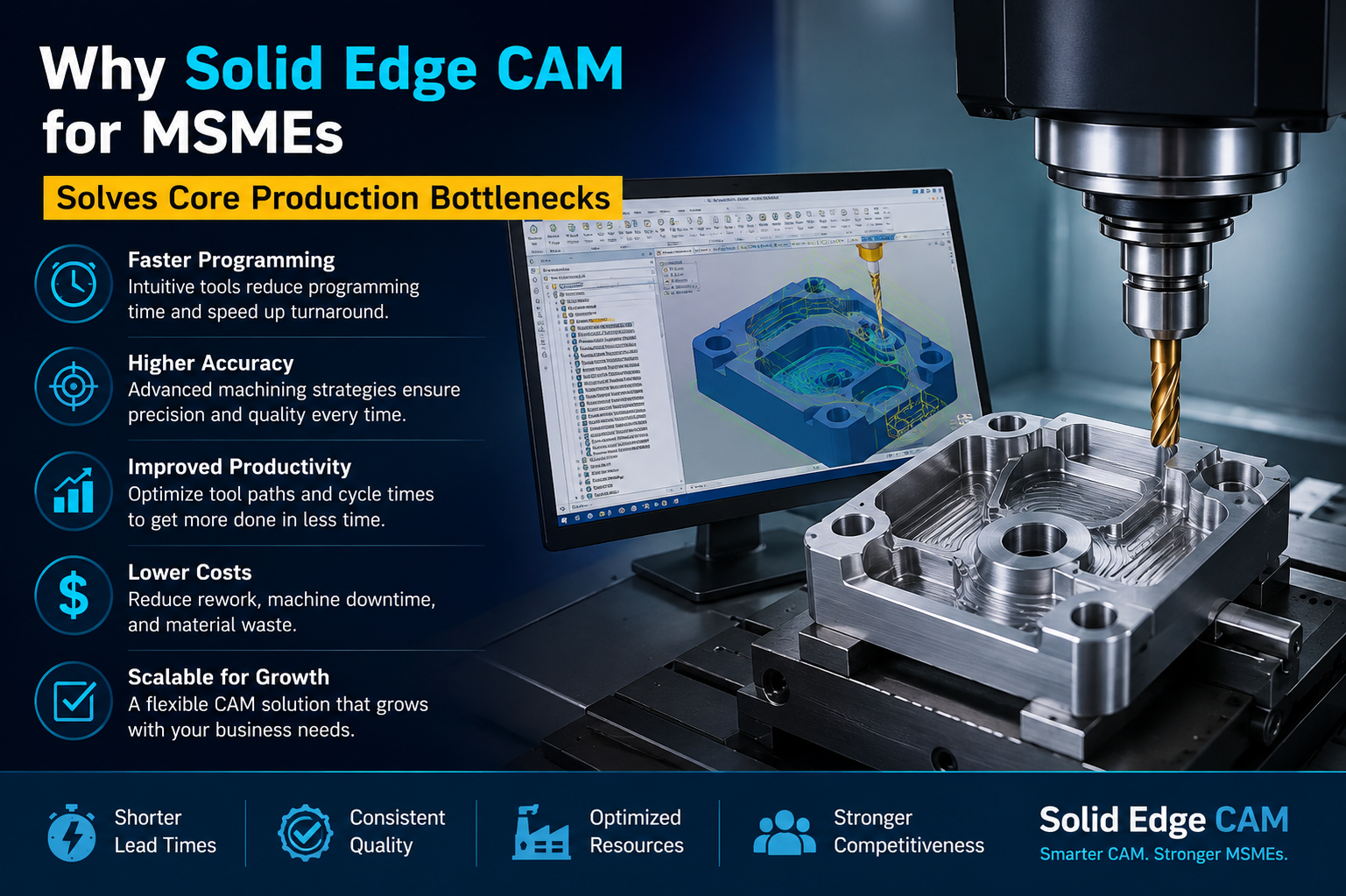
Solid Edge integrates directly with the core design environment. You open the file, generate the toolpath, and post the code. If the engineering design changes, your toolpaths update automatically. We see this exact workflow save our clients hours of redundant programming every single week at CJ Tech.
Why do machine setups take longer than the actual machining cycle? Operators lack clear, visual setup instructions. Solid Edge provides accurate shop floor documentation automatically based on the programming data. The setup sheet matches the exact digital twin of the tooling and fixturing.
You spend significant time building a tooling library. You enter the exact feeds, speeds, and stick-out lengths for your cutters. If that database doesn’t communicate cleanly with the programming environment, you re-enter data manually for every job. Solid Edge links directly to your tooling library. You select a 1/2-inch endmill, and the system populates the optimal cutting parameters automatically. The second shift runs the job exactly like the first shift.
Measurable impacts on MSME manufacturing overhead
Let’s look at the actual numbers. We compiled data from small job shops transitioning to integrated machining systems.
| Metric | Legacy Systems | Integrated Solid Edge Environment |
| Programming Time | 4-6 hours per complex part | 1-2 hours per complex part |
| Design Revision Delay | Requires full reprogramming | Automatic toolpath update |
| Scrap Rate (First Article) | 12% to 15% average | Under 4% |
| Machine Setup Time | High (relies on manual verification) | Low (digital simulation verification) |
Upgrading your Manufacturing software infrastructure
You need predictable machining to quote accurately. When you bid on a job, you need to know exactly how long it will take to cut the material. The software gives accurate cycle times based on your specific machine kinematics. You stop guessing on your quotes.
Complex setups kill your profit margin. Moving a part across three different machines requires three different fixtures and three separate zero points. Error stacks up with every move. Programming a 4-axis rotary or a 5-axis trunnion allows you to hit multiple faces in a single setup. The challenge is generating safe code for those complex rotational moves. The system handles the kinematics visually. You see the trunnion rotate on screen, verifying clearances before you ever load raw stock.
Consider the reality of finding skilled CNC programmers today. They are rare and expensive. You cannot afford to have them doing menial data entry or fixing broken IGES files. You need them optimizing toolpaths and reducing cycle times.
Here are practical changes you will observe on the shop floor:
- Your operators stop manually editing code at the controller interface.
- Tool life increases because the software maintains consistent chip loads during roughing operations, reducing sudden spikes in cutting force.
- Scrap bins stay empty longer.
- Customer revisions are handled in minutes rather than days by updating the model and regenerating the paths.
Why investing in the right CAM software matters now
Raw material costs heavily impact your margin. When you scrap a block of titanium because the post-processor inserted a rogue G0 rapid move into the workpiece, that mistake eats the profit of the entire batch. You need a system that verifies exactly what the machine will do. Solid Edge uses actual G-code simulation. You are verifying the precise code that the controller reads.
Tooling budgets drain rapidly when feeds and speeds are inconsistent. Traditional methods plunge tools aggressively into corners, spiking the load on the cutter. You hear the chatter across the shop. The endmill chips or snaps. Integrated software calculates constant chip thickness, adjusting the feed rate dynamically as the tool engages different volumes of material. You buy fewer endmills each month.
What is the biggest hidden cost in a CNC machine shop? Machine idle time. If the spindle is not turning, you are losing money. Implementing robust Manufacturing software directly impacts how many jobs you can ship in a month.
We help job shops implement these exact workflows. We look at the machines you have on the floor and configure the post-processors to match your specific controllers. You don’t have to figure out the integration alone. Using advanced Manufacturing software is no longer restricted to massive aerospace corporations. The tools have scaled to fit the budget and reality of smaller shops.
Your shop floor efficiency dictates your profit margin. Eliminating the disconnect between receiving a 3D model and cutting metal is mandatory. Predictable toolpaths, automatic updates for design changes, and accurate machine simulation are practical requirements for taking on tighter tolerance jobs. Solid Edge provides this environment natively. To start optimizing your machine uptime, schedule a review with us and get an accurate ETA for your implementation.
FAQs
What makes Solid Edge CAM for MSMEs different from standalone solutions?
It integrates directly with the design data. When a part design changes, the toolpaths update automatically without requiring manual reprogramming from scratch.
How long does it take an operator to learn this CAM software?
Most machinists adapt within a few days. The interface is built around machining logic rather than complex computer programming, making it intuitive for people who actually run CNC machines.
Do we need to replace our current CAD system to use new CAD CAM software?
No. Solid Edge handles multiple file formats effortlessly. You can import customer files from almost any system, repair the geometry quickly, and proceed straight to machining.
How does MSME manufacturing benefit from machine simulation?
Simulation visualizes the exact cutting process digitally. You catch gouges, fixture collisions, and tool limit errors on a screen instead of crashing a physical spindle on the shop floor.