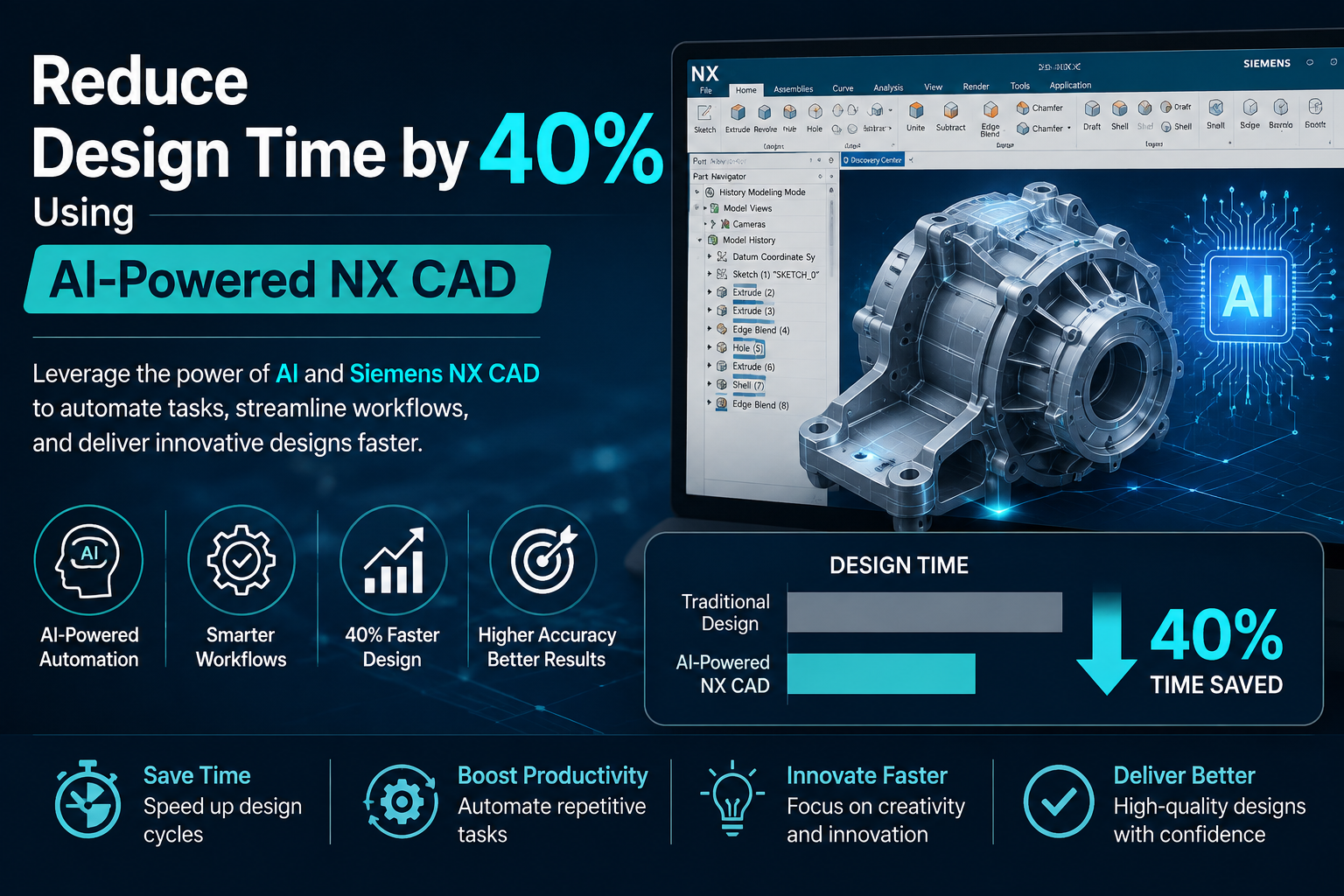
Forty percent is not a marketing number we picked out of thin air. It is the kind of gap we see when a design team moves from manual iteration to Siemens NX AI tools inside their everyday CAD workflow. Fewer redraws, faster generative iterations, and design validation that happens before a part ever reaches the shop floor.
We are CJ Tech, an authorised Siemens PLM channel partner working with over 250 manufacturers across India, from automotive suppliers to aerospace and railway teams. This blog walks through where AI CAD software actually saves you time on real projects, not just in a demo.
Why Siemens NX AI Changes the Design Time Equation
Most design delays do not come from the actual modeling. They come from redoing work: fixing a clash you missed, running the same load case three times because the first geometry failed, or manually generating variants for a customer review.
AI Mechanical Design tools inside NX target exactly those repeat cycles. Instead of you manually testing five wall-thickness options, the software runs the variations and flags the ones that actually meet your constraints. That is where the time comes back.
Where AI in Product Design Saves the Most Hours
We have grouped the biggest time savings we see in client projects into three areas.
Generative Design and Topology Optimization
- Generative design in NX proposes geometry based on load cases, material limits, and manufacturing constraints you set upfront.
- Topology optimization strips unnecessary mass automatically, so you are not manually thinning ribs and walls through trial and error.
- Designers review and select from viable options instead of building each option from scratch.
Automated Feature Recognition and Rule Checking
- AI-assisted feature recognition flags manufacturability issues, like a hole too close to an edge, while you are still modeling, not after the part goes to CAM.
- Rule-based design checks catch standard-part violations automatically, cutting the review cycle with your quality team.
- This matters most for AI CAD for Manufacturing workflows, where a design change late in the process is expensive to fix on the shop floor.
Simulation-Driven Iteration
- Built-in simulation lets you test a design against real loads without exporting to a separate tool and waiting on results.
- Faster feedback loops mean your engineers make five iterations in the time it used to take for two.
- Fewer physical prototypes get built, which saves both time and material cost.
How Much Time Are Manufacturers Actually Saving
Here is a general picture based on patterns we see across client projects using AI CAD software inside their NX environment. Individual results vary by part complexity and how mature the team’s existing CAD process is.
| Design Task | Traditional CAD Workflow | With AI-Powered NX CAD |
| Generating design variants for review | 3-5 days of manual iteration | Hours, with automated variant generation |
| Topology optimization on a structural part | Multiple manual weight-reduction passes | Single automated optimization run |
| Catching manufacturability issues | Found during CAM or on the floor | Flagged during design, before CAM |
| Running load simulations | Exported to separate tool, queued | Run inside NX, faster turnaround |
| Overall design cycle time | Baseline | Up to 40% reduction, reported by teams we have supported |
Real Problems AI CAD for Manufacturing Actually Solves
If any of these sound familiar, this is exactly where AI-assisted tools in NX help:
- Your team keeps discovering a part will not machine cleanly only after it reaches CAM programming.
- Engineers spend more time manually generating design variants than actually deciding between them.
- Weight-reduction passes on structural components eat days of manual trial and error.
- Simulation feedback comes back too late to change the design cheaply.
- Every design review needs a fresh round of manual documentation before it can even start.
Getting Started with Siemens NX AI on Your Existing Workflow
You do not need to rebuild your CAD process from zero to see these gains. Most of our clients start by applying AI Mechanical Design tools to one part family, usually a structural or high-iteration component, before rolling it out further.
We help with the setup that matters most: configuring generative design constraints correctly, connecting simulation results back into the CAD model, and training your team on where AI in Product Design tools actually add value versus where manual control still matters.
Conclusion
A 40% reduction in design time does not come from one feature. It comes from removing the repeat work, the manual variant generation, the late-stage manufacturability surprises, that eat your engineers’ week without anyone noticing until the deadline is close. Siemens NX AI gives you the tools to remove that repeat work; how you configure and adopt it determines whether you actually see the gain.
We have spent over 15 years helping manufacturing teams across India get real value out of their Siemens NX investment, and AI-powered CAD is the next step for most of the design teams we work with. If your design cycles are running longer than they should, talk to our CJ Tech team about where AI-powered NX CAD fits into your current workflow.